
Navigating the requirements for documents intended for international use can feel like traversing a complex legal landscape, where terms like ‘apostille’ and ‘legalisation’ create uncertainty and the risk of costly errors is high. This is precisely where the specialist function of a UK notary public becomes indispensable-a role distinct from, and often misunderstood in relation to, that of a solicitor. Their seal is the internationally recognised mark of authenticity that ensures your most critical paperwork is accepted without question across borders.
This definitive guide is engineered to transform that uncertainty into strategic clarity. We will demystify the notarisation process, articulate when and why you need a notary’s services, and provide a clear roadmap for ensuring your documents are correctly prepared for global use. By the end, you will not only understand the process but will be empowered to manage it with confidence, securing the international validity your affairs demand.
Key Takeaways
- Understand the unique role of a notary public, a specialist legal professional whose primary function is to authenticate documents for official use abroad.
- Identify the specific personal and commercial scenarios requiring notarisation, from granting a power of attorney overseas to verifying corporate documents for international trade.
- Navigate the document notarisation journey with confidence, from initial preparation and identity verification through to the official signing and sealing of your documents.
- Discover the critical next steps beyond notarisation, including when an Apostille or further Embassy Legalisation is required to ensure full international acceptance.
Defining the Notary Public in the United Kingdom
In the sophisticated ecosystem of UK legal services, the notary public occupies a distinct and ancient position. As one of the oldest legal professions, their primary function is highly specialised: to authenticate and certify documents so they are legally recognised and accepted in foreign jurisdictions. For those seeking a foundational understanding of the role, exploring what a Notary Public is reveals their status as impartial, state-appointed officials. Their core purpose is to act as a trusted gateway, ensuring that legal documents prepared in the UK hold weight and validity on the international stage. This vital function sets them apart from other legal practitioners whose focus is typically domestic.
The Unique Role and Authority of a Notary
A notary’s authority is not derived from the same sources as a solicitor’s but is granted by the Court of Faculties of the Archbishop of Canterbury. This appointment tasks them with serving the public in non-contentious matters requiring international verification. The official seal and signature of a notary are recognised globally as an assurance of authenticity. In essence, a notary public acts as a strategic bridge between the UK’s legal framework and those of other nations, facilitating seamless cross-border transactions and legal processes.
Key Responsibilities: Beyond Just a Signature
The duties of a notary are precise and demand meticulous attention to detail. While the application of their seal is the final step, the process involves several critical responsibilities designed to prevent fraud and ensure the integrity of the document. Key functions include:
- Verifying the identity and legal capacity of signatories.
- Authenticating signatures on legal documents.
- Certifying that copies of documents are true replicas of the original.
- Administering oaths, affirmations, and statutory declarations.
- Witnessing the execution of crucial documents such as international Powers of Attorney, corporate records, and property deeds for use abroad.
Notary Public vs. Solicitor: Clarifying the Crucial Distinction
A common point of confusion is the difference between a notary and a solicitor. The distinction is fundamental: solicitors primarily advise on matters within English and Welsh law, representing clients in disputes and domestic transactions. In contrast, notaries are focused on the authentication of documents specifically for use in foreign countries. While some solicitors are also qualified notaries, the two roles are legally separate. An effective analogy is to view a solicitor as your expert for domestic legal journeys, while a notary is the official required for international validation.
When is a Notary Public Required? Common Scenarios
Understanding when to engage a notary public is crucial for individuals and businesses operating on an international stage. The fundamental requirement arises when a document, created or signed in the United Kingdom, must be presented as legally valid within a foreign jurisdiction. This need is not dictated by UK law, but rather by the specific legal and administrative rules of the recipient country. A notary public acts as a bridge between these legal systems, providing a formal verification that foreign authorities can trust. The standards for this specialised role are meticulously maintained by professional bodies such as The Notaries Society, ensuring integrity across all notarised documents.
To clarify when you might need these services, we have categorised the most common scenarios below.
Personal Documents for International Use
Significant life events that cross international borders often require the formal validation that only a notary can provide. These situations demand an unimpeachable level of verification to be accepted by overseas authorities.
- Powers of Attorney: Granting someone legal authority to buy, sell, or manage your property in another country.
- Emigration and Family Matters: Preparing documents for visa applications, overseas marriage, or international adoption proceedings.
- Professional and Academic Credentials: Certifying degree certificates, transcripts, or professional accreditations for securing employment abroad.
- Legal Declarations: Swearing affidavits, statutory declarations, or witness statements for use in foreign court cases or legal processes.
Commercial and Corporate Documents
For businesses expanding their global footprint, notarisation is an essential step in facilitating seamless cross-border operations and ensuring corporate compliance in foreign markets.
- Corporate Governance: Certifying the identity of company directors and other officers or verifying the minutes of a board meeting.
- International Expansion: Authenticating the necessary corporate documents to establish a foreign branch, subsidiary, or overseas bank account.
- Commercial Agreements: Witnessing the execution of high-value international contracts, deeds, or trade finance agreements to ensure their validity abroad.
- Global Trade: Verifying shipping documents, certificates of origin, and other export-related paperwork to satisfy customs and import regulations.
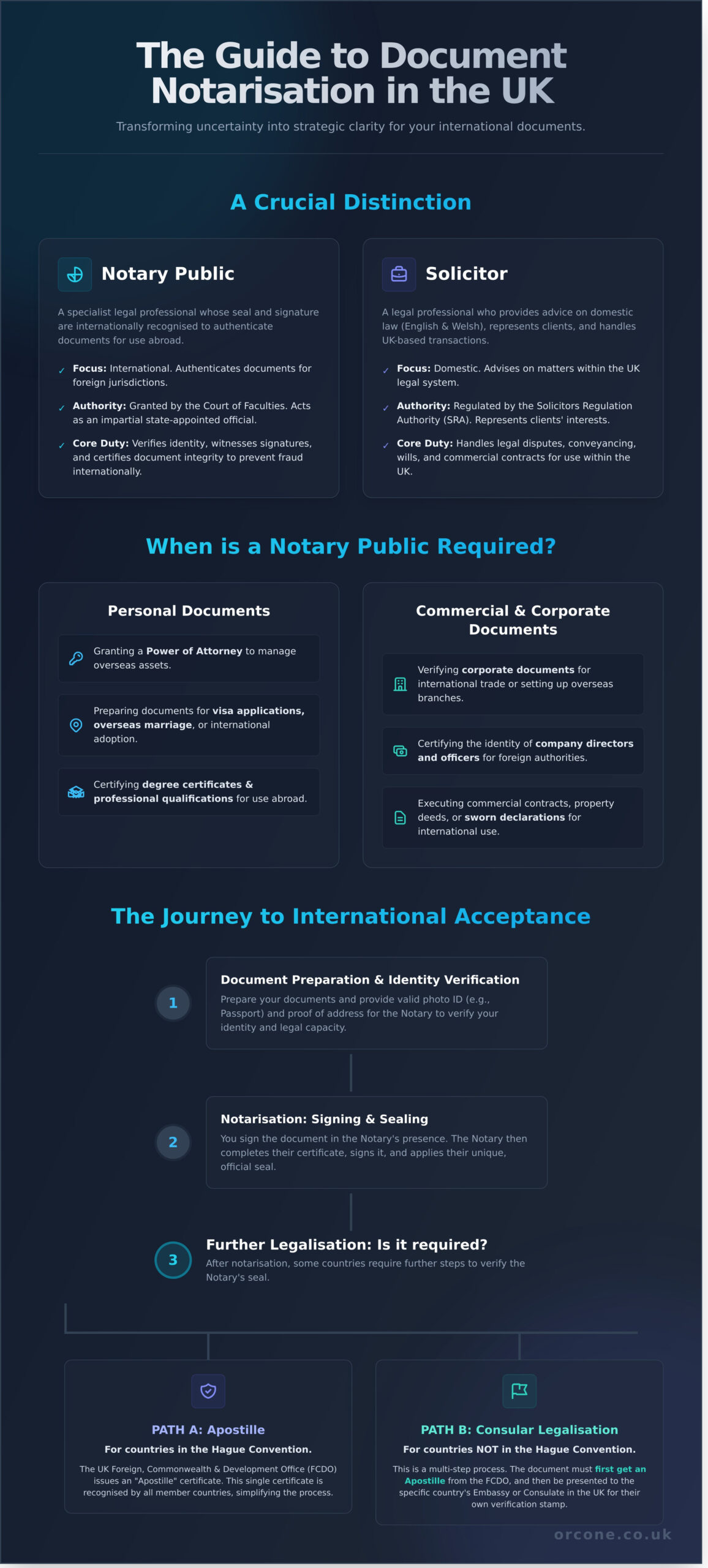
The Document Notarisation Process: A Step-by-Step Journey
Engaging a notary is the first step in a precise and structured journey to give your documents international legal standing. This process is not a mere formality; it is a meticulous framework designed to provide absolute assurance to overseas authorities. Understanding each phase of this journey demystifies the path to a fully authenticated document and highlights the value delivered at each stage.
Preparation: What to Bring to Your Appointment
To ensure a seamless and efficient appointment, thorough preparation is paramount. You will be required to present specific items that form the basis of the notarial act, allowing the process to proceed without delay. Please ensure you have the following:
- The Complete Document: Bring the final version of the document that requires notarisation. Crucially, do not sign it beforehand.
- Valid Photo Identification: An original, current passport or photocard driving licence is standard. The ID must be government-issued and contain your photograph and signature.
- External Instructions: Any letter, email, or guidance you have received from the foreign lawyer, court, or authority requesting the document. This provides essential context for the notary.
- Proof of Address: In some cases, such as confirming your place of residence, a recent utility bill or bank statement may be necessary.
The Notarial Act: What to Expect During the Appointment
During your appointment, the notary public executes their core function with precision. The notary will first verify your identity against your official documentation, establishing a clear link between you and the document. They will then engage with you to confirm that you fully comprehend the document’s nature and are signing it freely, without coercion. You will then sign the document in their physical presence, after which they will complete the process by affixing their own signature, a unique official seal, and a formal statement known as the notarial certificate.
The Final Document: Understanding the Notarial Certificate
The addition of the notary’s certificate, signature, and seal is what transforms your document, making it official for use abroad. This official attestation serves as internationally recognised evidence that the signature is genuine and that the signatory’s identity and capacity were properly verified according to strict legal standards. It is vital to understand that the notary authenticates the act of signing, not necessarily the factual accuracy of the document’s contents. This distinction is fundamental to the integrity of the notarial system, providing a trusted verification of identity and intent for global transactions.
After Notarisation: The Path to Full International Acceptance
Securing the signature and seal of a notary public is the foundational first step in validating your document for international use. However, this is often the beginning, not the end, of the authentication journey. For a UK-issued document to be fully recognised by foreign authorities, it must typically undergo further stages of verification, a process that transforms it from a locally attested document into a globally accepted one.
The Next Stage: Securing an Apostille from the FCDO
For countries that are signatories to the Hague Convention of 1961, the next logical step is obtaining an Apostille. This is a certificate issued by the UK’s Foreign, Commonwealth & Development Office (FCDO) which verifies the authenticity of the notary’s signature and seal. It acts as a universal form of validation, confirming to the receiving country that the notarial act is legitimate. Navigating the FCDO’s requirements can be complex and time-consuming. Let us manage the Apostille process for you.
When is Embassy Legalisation Necessary?
If your document is destined for a country that is not a member of the Hague Convention, a final, more specific step is required: Embassy Legalisation. After the document has been notarised and issued with an Apostille by the FCDO, it must then be presented to the UK-based embassy or consulate of the destination country. They will add their own stamps or certificates, confirming its validity for use within their jurisdiction. Countries such as the UAE, China, and Qatar frequently require this final layer of authentication.
A Seamless, Integrated Service for Global Documents
Managing each stage of this process-notarisation, Apostille, and embassy legalisation-independently creates inefficiencies and introduces the risk of costly errors or delays. A single misstep can lead to document rejection, disrupting critical business or personal timelines. Orcone provides a bespoke, end-to-end solution, acting as your single, expert partner for the entire journey. We optimise the workflow, ensuring every requirement is met with precision, transforming a complex, multi-stage procedure into a seamless, managed service that guarantees international compliance.
Finding and Instructing a Notary Public in the UK
Securing the services of a qualified notary public is the final, critical stage in validating your documents for international use. The challenge lies not just in finding a professional, but in selecting one whose expertise aligns with your specific jurisdictional requirements and who operates with the transparency necessary for a seamless process. Making an informed choice at this stage is paramount to avoiding costly delays and potential rejection of your documents abroad.
How to Locate a Reputable Notary
A strategic approach to sourcing a notary ensures you engage a professional capable of navigating the specific complexities of your request. To optimise your search and selection process, consider the following criteria:
- Official Directories: The most reliable starting point is the official directory maintained by The Notaries Society, which lists all qualified and regulated notaries in England and Wales.
- Jurisdictional Experience: Always enquire about the notary’s experience with documents destined for your target country. A professional with established expertise in that region can pre-empt common issues.
- Transparent Engagement: A reputable notary will communicate their process and pricing structure clearly from the outset, providing a foundation of confidence and clarity for your engagement.
Understanding Notary Fees and Pricing Structures
The cost of notarial services in the UK is not fixed and reflects the complexity and time required for each unique instruction. Typically, fees are calculated on a time-spent basis or as a set fee per document. For a straightforward notarial act, such as verifying a signature on a power of attorney or certifying a passport copy, you can expect costs to range from £60 to £150.
More complex commercial documents, multi-document bundles, or those requiring bespoke drafting will naturally incur higher fees. It is essential to obtain a clear, itemised quote before instructing a notary public to ensure there are no ambiguities regarding the total cost, which may also include disbursements for legalisation or courier services.
Engaging a firm that provides a comprehensive, end-to-end service transforms a fragmented task into a streamlined journey. At Orcone, we manage the entire lifecycle, from initial consultation to final apostille and legalisation, ensuring your documents are meticulously prepared for global acceptance. Contact our team to discuss your requirements.
Transforming Complexity into Clarity: Your Document’s Journey Forward
Navigating the landscape of international document verification demands precision. As we have explored, the role of a notary public is a critical first step, providing the initial authentication for documents destined for overseas use. However, achieving full international acceptance often requires a more comprehensive journey, progressing from notarisation to the crucial stages of Apostille and Embassy legalisation.
This is where a strategic partner becomes invaluable. At Orcone, we transform this intricate process into a seamless experience. As a trusted service registered with the UK Foreign, Commonwealth & Development Office (FCDO), we provide comprehensive Apostille and Embassy legalisation solutions. We deliver a bespoke service meticulously tailored to your specific personal or commercial document requirements. Begin your document legalisation journey with our expert team. Allow us to architect the path to your document’s international validity, ensuring a successful outcome for your venture.
Frequently Asked Questions
How much does a Notary Public cost in the UK?
Notary Public costs in the UK are bespoke to the service required. A straightforward notarisation of a single document typically starts from £80 to £150. However, the final fee is influenced by the document’s complexity, the time required for verification, and whether additional services like legalisation (Apostille) are necessary. It is always advisable to request a detailed quote upfront to ensure full transparency and budget accurately for your specific requirements.
Can a UK solicitor notarise a document for use abroad?
While a UK solicitor can certify many documents for domestic use, they generally cannot notarise a document intended for an overseas jurisdiction. Notarisation for international purposes is the exclusive domain of a Notary Public, a distinct legal professional whose seal and signature are recognised globally. Engaging the correct professional from the outset is a critical step to ensure your document’s seamless acceptance and prevent costly delays.
What is the difference between a certified copy and a notarised copy?
A certified copy is a photocopy of an original document which a professional, such as a solicitor, has confirmed is a true likeness. In contrast, a notarised copy involves a more rigorous process. The notary verifies the authenticity of the original document itself, confirms the identity of any signatory, and then affixes their official seal. This provides a higher level of assurance, which is typically a mandatory requirement for documents used in foreign legal systems.
Do I need to see the Notary Public in person?
Traditionally, a personal appearance before the Notary Public is essential. This allows the notary to perform robust identity verification and witness your signature, which are foundational to the notarisation process. While some jurisdictions are beginning to accept remote notarisation, in-person appointments remain the most widely accepted and secure method. We recommend confirming the requirements of the receiving authority to determine the appropriate course of action.
How long does the document notarisation process typically take?
The notarisation appointment itself is often efficient, usually completed within 15 to 30 minutes for straightforward matters. However, the overall timeline can be extended if your document requires legalisation via an Apostille from the Foreign, Commonwealth & Development Office (FCDO). This additional governmental step can add several working days to the process. We advise planning accordingly, especially when operating under tight international deadlines.
What happens if I sign my document before the notary appointment?
It is imperative that you do not sign your document before attending your appointment. A core function of the notary is to witness the act of signing, thereby verifying the signatory’s identity and intent at that precise moment. If you arrive with a pre-signed document, you will be required to sign it again in the notary’s presence. This may necessitate printing a fresh, unsigned copy of the document to ensure its procedural validity.