
The ambition to live and work abroad often begins with a compelling vision, only to be met by the complex reality of international bureaucracy. Vague terms, intricate document requirements, and the fear of a rejected application can quickly transform excitement into apprehension. For many UK citizens, the process is obscured by unfamiliar terminology, including the frequently encountered but often misunderstood alien resident certificate, creating a significant friction point on the journey to a new life overseas.
This guide is designed to transform that complexity into clarity. We will provide a strategic framework for understanding global residency documents and, crucially, for preparing your UK-issued paperwork with precision. We will navigate the critical distinctions between an apostille and embassy legalisation, delivering an actionable checklist to optimise your application process. You will emerge from this article not with uncertainty, but with the quiet confidence required to manage your documentation seamlessly and successfully.
Key Takeaways
- Discover the essential legalisation process-apostille or embassy authentication-required to make your UK documents valid for any residency application abroad.
- Understand that while the term alien resident certificate is specific to certain countries, the core principles of proving your identity apply to all global residency applications.
- Recognise how your reason for relocation, whether for a career, education, or family, dictates the bespoke set of authenticated documents you will need to prepare.
- Learn a strategic framework for navigating the application journey, minimising complexity and maximising your chances of a successful outcome.
Defining the Alien Resident Certificate: A Global Perspective
Navigating international documentation can be complex, particularly when terminology varies between jurisdictions. While the term ‘Alien Resident Certificate’ is specific to Taiwan, the concept it represents is universal: a formal confirmation of a foreign national’s right to reside long-term. Understanding this document is the first critical step in the journey towards its legalisation for use in the UK.
What is an Alien Resident Certificate (ARC)?
An ARC is an official identity card issued by Taiwan’s National Immigration Agency to foreign nationals who intend to stay for more than 180 days. It serves as your primary proof of legal status. Fundamentally, the Alien Resident Certificate is the cornerstone of a foreign national’s legal identity within Taiwan, containing crucial information such as your photograph, full name, passport number, and the specific basis of your residency (e.g., work, study, or joining family).
Beyond its legal function, the ARC is an indispensable tool for daily life. It is essential for a range of administrative and commercial activities, including:
- Opening a local bank account
- Registering for National Health Insurance
- Signing a lease for accommodation
- Obtaining a Taiwanese driving licence
Visa vs. Residence Permit: Understanding the Key Difference
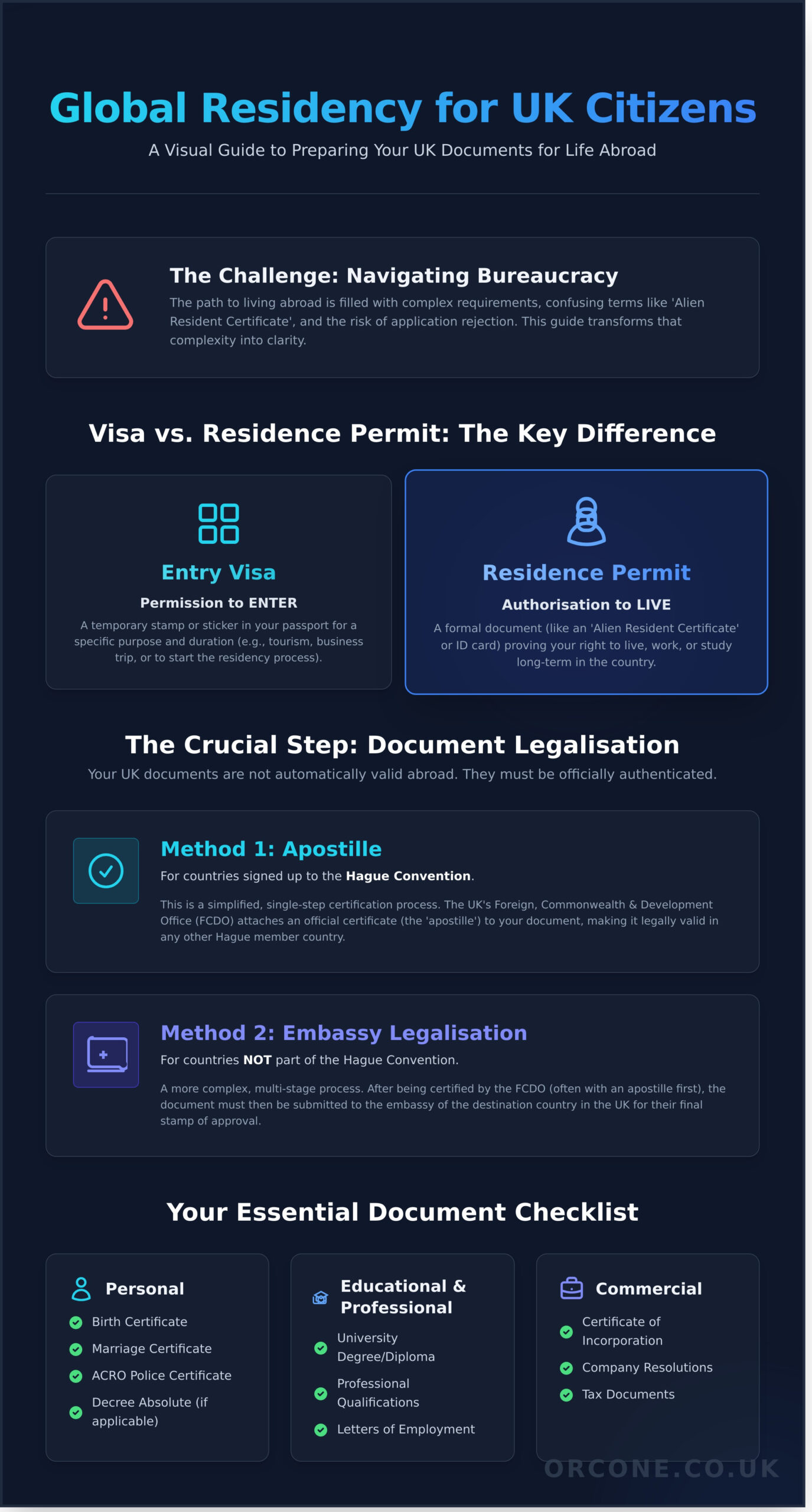
It is crucial to distinguish between an entry visa and a residence permit like the ARC. A visa is typically a sticker or stamp in your passport that grants you permission to enter a country for a specific purpose and duration. In contrast, a residence permit is the formal document that authorises you to live there long-term.
The process often involves a two-stage journey. You first secure a Resident Visa from a Taiwanese diplomatic mission abroad. Upon arrival in Taiwan, you must then use this visa to apply for and convert it into your physical alien resident certificate. This is analogous to the system in the UK, where one might enter on a visa and is then issued a Biometric Residence Permit (BRP) to prove their ongoing right to live, work, or study.
The Crucial Role of UK Documents in Securing Your Residency Permit
Securing an alien resident certificate in a foreign jurisdiction like Taiwan is a journey that demands meticulous preparation, beginning long before you submit your application. Foreign governments require incontrovertible proof of your identity, status, and qualifications to validate your eligibility. These proofs are your official UK-issued documents, and their correct presentation is non-negotiable. Failure to provide documents that have been correctly authenticated through the official UK process to get your document legalised can result in significant delays or outright rejection, jeopardising your entire relocation strategy. Proactive preparation is therefore the cornerstone of a successful application.
Common Personal Documents Required
These documents form the bedrock of your application, verifying your personal identity and civil status. They provide the foundational evidence upon which your eligibility is assessed, particularly for family or spousal-based residency.
- Birth Certificate: The primary document to prove your identity and parentage.
- Marriage Certificate: Essential for applications based on a marital relationship.
- ACRO Police Certificate: A standard requirement to provide a verifiable criminal record check from the UK.
- Decree Absolute: Required to prove the dissolution of a previous marriage if your status has changed.
Essential Educational and Professional Documents
For those seeking residency based on employment or academic pursuits, these documents are critical. They substantiate the claims made in your application regarding your qualifications and professional standing, directly impacting your eligibility for a work or study-based alien resident certificate.
- University Degree/Diploma: Verifies your academic credentials for skilled worker or student applications.
- Professional Qualifications: Validates specific certifications required for regulated professions.
- Letters of Employment: Offer proof of your work history, skills, and professional experience.
Key Commercial Documents for Business-Related Residency
Entrepreneurs and business owners must provide a distinct set of documents to prove the legitimacy and viability of their commercial activities. These papers demonstrate your business’s legal standing and financial history, forming a critical part of any investment or business-related residency application.
- Certificate of Incorporation: Confirms the legal establishment of your UK company.
- VAT Certificate: Demonstrates a history of business activity and tax compliance.
- Power of Attorney: A legal instrument to authorise a representative to act on your behalf in business matters abroad.
Apostille vs. Embassy Legalisation: Preparing Your Documents Correctly
A critical misstep in any international application is assuming a UK-issued document is automatically valid abroad. Whether you are applying for a visa, work permit, or an alien resident certificate, your documents must first undergo a formal authentication process. This journey of validation transforms a domestic certificate into a globally recognised instrument. The specific path required is dictated entirely by the destination country’s international treaty memberships, and selecting the incorrect one will result in immediate rejection, costing you valuable time and resources.
Navigating the requirements for Moving or retiring abroad can be complex, but understanding the two primary legalisation frameworks is the first step towards a seamless application.
The Apostille Process: For Hague Convention Countries
For countries that are signatories to the 1961 Hague Convention, the process is significantly streamlined. An Apostille is a specialised certificate issued by the UK’s Foreign, Commonwealth & Development Office (FCDO). It is physically attached to your original document, acting as a definitive verification of the signature, seal, or stamp it bears. This single-step certification is recognised by over 120 member nations, creating an efficient and standardised system for document acceptance across borders.
Embassy Legalisation: The Multi-Step Alternative
When your destination country is not a member of the Hague Convention-common examples include the UAE, Qatar, and China-a more intricate process known as Embassy Legalisation is required. This is a multi-layered journey that begins with securing a UK Apostille. Following this, the document must be presented to the London-based embassy of the destination country for further attestation. This additional stage adds significant complexity, cost, and processing time to your application.
Which Process Do You Need?
The first strategic step is to identify whether your destination country is a Hague Convention member. While Taiwan is a de facto member and accepts the Apostille, it is imperative to always confirm the precise requirements with the relevant consulate or representative office. The standards for an alien resident certificate application are exacting, and official guidance is non-negotiable. To eliminate uncertainty and ensure your documents are prepared with absolute precision from the outset, let our experts manage the entire legalisation journey for you.
Common Scenarios Requiring a Residence Permit for UK Nationals
The journey to securing a residence permit is not a uniform process; it is a bespoke pathway dictated entirely by your reason for relocating. Whether for work, study, or family, each scenario demands a specific portfolio of authenticated UK documents to satisfy foreign authorities. Proactive planning is therefore not just beneficial-it is critical to ensuring a seamless transition and the successful acquisition of your visa or alien resident certificate. We will now explore three common pathways for UK citizens moving abroad.
Residency for Employment
For professionals seeking to work overseas, the primary challenge lies in validating your qualifications. This almost invariably requires an apostille on key documents such as university degree certificates and professional accreditations. Furthermore, an ACRO Police Certificate is a mandatory component for most work visa applications, providing a verified record of your criminal history. For certain destinations, like Saudi Arabia or the UAE, the process extends beyond an apostille to require full embassy legalisation, adding a significant layer of complexity.
Residency for Study
Students planning to enrol in foreign institutions must provide a different set of verified documents, where the focus is on proving identity and academic history. Essential paperwork includes:
- An apostilled full-form birth certificate.
- Authenticated academic transcripts from your previous school or university.
- Notarised proof of financial means to cover tuition and living costs.
The cornerstone of the application, however, remains the official acceptance letter from the educational institution, which validates your purpose for entry.
Residency for Family Reasons
When relocating to join family or to marry, the objective is to legally substantiate your relationships through apostilled civil status documents. An apostilled marriage certificate is needed to join a spouse, while birth certificates are used to prove parent-child connections. If you have been previously married, a Decree Absolute may be required to prove you are legally free to remarry, and a Certificate of No Impediment (CNI) is often a prerequisite for getting married in another country. Properly preparing these documents is the first step in securing your alien resident certificate for family unification.
Navigating this complex documentation journey requires meticulous attention to detail; our specialists can help optimise the process for you.
Navigating the Application Process: A Strategic Checklist
Securing an Apostille for documents intended for a Taiwanese residency application is a journey that demands precision and foresight. A structured, methodical approach is not merely beneficial; it is essential to minimise stress, mitigate the risk of costly errors, and ensure a seamless transition. This high-level framework deconstructs the process into distinct, manageable phases, clarifying the critical path to a successful application.
Each step represents a vital component in the ecosystem of your application. While the journey is yours, professional guidance can transform the most complex stages from potential obstacles into streamlined milestones, ensuring your submission for the alien resident certificate is both compliant and compelling.
Phase 1: Research and Document Collation
The foundation of a successful application is built upon meticulous preparation. Before any documents are submitted, you must first establish a clear understanding of the precise requirements. This initial discovery phase prevents wasted time and resources later in the process.
- Confirm Requirements: Engage directly with the Taiwanese Representative Office in the UK to verify the exact document and residency criteria for your specific circumstances.
- Gather Originals: Collate all necessary original UK documents, such as your birth certificate, marriage certificate, or professional qualifications.
- Check Validity: Scrutinise the issue dates of all documents. Time-sensitive certificates, like an ACRO Police Certificate, have a limited validity period that must be respected.
Phase 2: Authentication and Legalisation
This phase is where the formal validation of your UK documents occurs, making them legally recognised in Taiwan. It is the most technical part of the journey, where precision is paramount. An expert partner can optimise this entire stage, guaranteeing compliance with FCDO and embassy protocols.
- Determine the Path: For Taiwan, your UK documents will require an Apostille from the Foreign, Commonwealth & Development Office (FCDO).
- Manage Submissions: Engaging a professional service ensures your documents are correctly prepared and submitted to the FCDO, avoiding common pitfalls that lead to rejection.
- Obtain Translations: If your UK documents are not in Traditional Chinese, you will almost certainly require certified translations to accompany the apostilled originals.
Phase 3: Application Submission
With fully legalised and translated documents in hand, the final phase involves the formal submission to the Taiwanese authorities. Meticulous attention to detail here ensures that your preparatory work culminates in a successful outcome for your alien resident certificate application.
- Complete Forms Accurately: Fill out all official residency application forms with complete and precise information, ensuring it matches your supporting documents perfectly.
- Submit Your Legalised Dossier: Present your complete package of apostilled and translated UK documents as instructed.
- Follow Submission Protocol: Adhere strictly to the embassy’s specific instructions for submission, payment of fees, and tracking the progress of your application.
While this checklist provides a strategic framework, successfully navigating the legalisation stage is the critical catalyst for your application. For bespoke guidance to transform this complex process into a seamless part of your journey, explore our specialist apostille services.
Securing Your Global Future: The Final Step in Your Residency Journey
Navigating the path to global residency is a significant undertaking. As we’ve explored, the process hinges on a meticulous understanding of international requirements, particularly the critical distinction between an Apostille and full embassy legalisation for your UK documents. A strategic, well-prepared application is not merely an advantage; it is the cornerstone of a successful outcome, preventing costly delays and potential rejections.
The complexities of securing an alien resident certificate demand precision and expert oversight. At Orcone, we transform this intricate process into a clear, manageable path forward. Trusted by individuals and corporations for secure document handling, we provide a bespoke service tailored to your destination country, offering strategic guidance through complex FCDO and embassy protocols. Begin your seamless document legalisation journey with Orcone and let our experts ensure your application is optimised for success. Your global ambitions are within reach.
Frequently Asked Questions
What is the difference between a visa and an Alien Resident Certificate?
A visa is typically a pre-entry clearance, permitting you to travel to and request entry into a country for a specific purpose and duration. In contrast, an alien resident certificate (ARC) is an identity document issued once you are in the country, confirming your legal right to reside there for an extended period. The ARC is fundamental for daily life, enabling you to open bank accounts, work, and access services, signifying a more permanent status than a temporary visitor’s visa.
How long does it take to get a UK document apostilled?
The timeline for obtaining a UK apostille is a critical planning component. The standard service offered by the Foreign, Commonwealth & Development Office (FCDO) typically takes up to 10 working days, though this can fluctuate with demand. For urgent requirements, a premium next-day service is available for an additional fee, ensuring your documents are processed swiftly. Strategically selecting the right service is key to optimising your application schedule and avoiding unnecessary delays in your journey.
Do I need to get my UK documents translated for a residency application?
When submitting UK-issued documents to Taiwanese authorities, a certified translation into Traditional Chinese is almost always a mandatory requirement. The legalisation process authenticates the UK document itself, but the receiving body in Taiwan must be able to understand its contents. It is imperative to engage a professional, accredited translator for this task to ensure the translation is officially recognised, thereby creating a seamless and compliant submission package for your residency application.
Can I use a photocopy, or do I need the original document for legalisation?
For the UK apostille process, the original document is almost always required to ensure its authenticity can be verified. This applies to vital records like birth certificates and academic qualifications. While a solicitor-certified photocopy may be accepted in rare, specific circumstances, relying on the original is the most direct and secure path. Submitting the correct format from the outset is a foundational step to prevent critical delays and ensure the integrity of your application is maintained.
What is the UK Biometric Residence Permit (BRP)?
A UK Biometric Residence Permit (BRP) is a card that holds a foreign national’s biographic details, biometric information, and immigration status within the United Kingdom. It serves as proof of the holder’s right to stay, work, or study in the UK. While it functions similarly to a Taiwanese alien resident certificate by confirming residency rights, the BRP is specific to the UK’s immigration ecosystem and should not be confused with residency permits from other jurisdictions.
How much does it cost to legalise a document for use abroad?
The cost of legalising a document through the UK’s FCDO is structured to accommodate different timelines. The standard apostille service is priced at £45 per document, plus courier fees. For more urgent needs, a premium service is available at £100 per document. These figures represent the government’s fees; you must also factor in potential additional costs for solicitor certification, if required, and secure postage to ensure a comprehensive budget for your legalisation journey.