
In an increasingly interconnected world, the need to authenticate official documents for international use is a critical, yet often complex, challenge. Whether you are expanding a business overseas, executing foreign property transactions, or verifying personal status for a new residency, the process can seem fraught with bureaucratic hurdles where a single error risks costly delays and rejection. This guide is engineered to transform that complexity into clarity, providing a definitive roadmap for securing an apostille UK certificate from the Foreign, Commonwealth & Development Office (FCDO).
We will demystify the entire journey, from identifying which documents require prior solicitor or notary certification to understanding the crucial difference between an apostille and full embassy legalisation. Our objective is to equip you with the strategic insight to navigate the system efficiently, ensuring your personal and commercial documents are correctly authenticated and accepted globally. Consider this your blueprint for achieving peace of mind and seamless international compliance.
Key Takeaways
- Grasp the strategic function of an apostille, the official certificate required to validate your UK documents for international use.
- Confidently identify which of your personal or commercial UK-origin documents are eligible for legalisation with our practical checklist.
- Navigate the official FCDO process with a clear, step-by-step walkthrough, demystifying the journey to securing an apostille uk certificate.
- Evaluate the complexities of the DIY approach and determine when engaging a professional service is the optimal strategy for a seamless outcome.
Understanding the Apostille: What It Is and Why You Need It
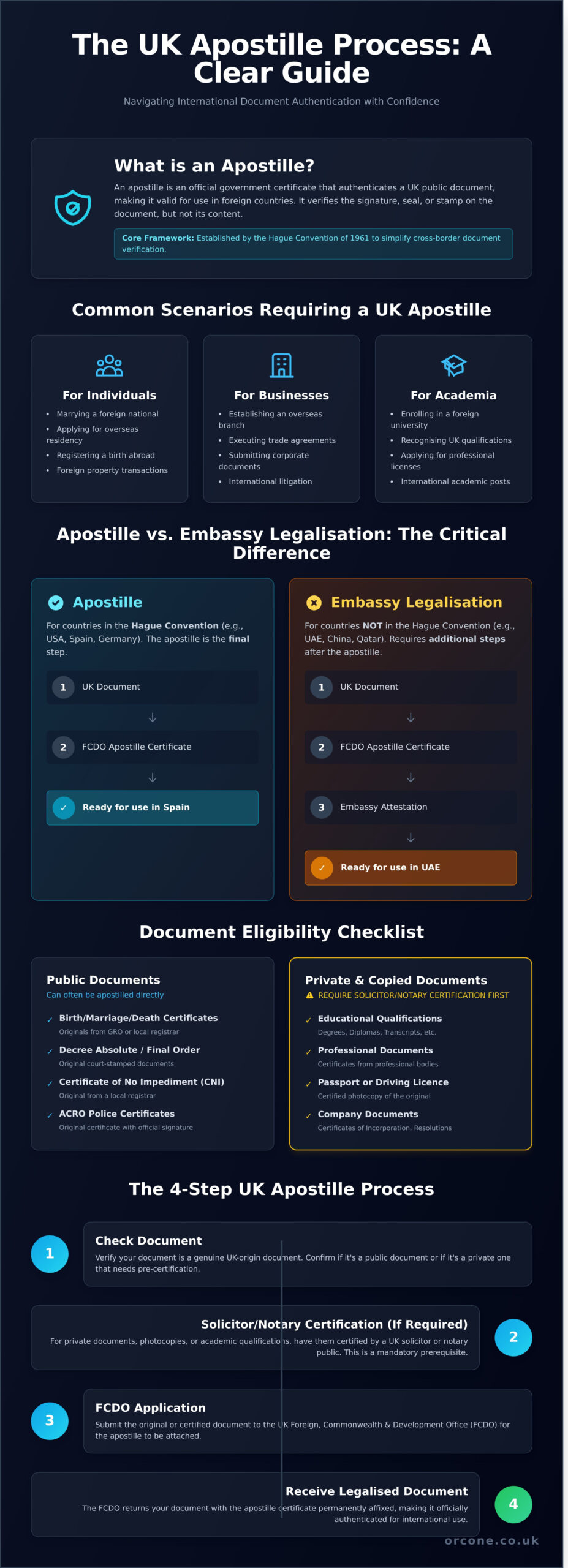
An apostille is an official government certificate that authenticates a public document, enabling its seamless acceptance in foreign countries. Its core purpose is to validate the origin of a UK-issued document, confirming the legitimacy of the signature, stamp, or seal it bears. It is crucial to understand that an apostille certifies the authenticity of the official’s mark, not the veracity of the document’s underlying content. This process is the cornerstone of international document legalisation for a significant portion of the world.
The Core Function of the Hague Apostille Convention
The modern apostille system was designed to simplify the traditionally complex journey of cross-border document verification. This streamlined framework was established by the Hague Convention of 1961, an international treaty that abolishes the need for lengthy, chain-authentication processes between member nations. Key signatories include the USA, Spain, Germany, and Australia. For non-member countries, a more intricate legalisation route is required.
Common Scenarios Requiring a UK Apostille
Navigating international personal or business affairs often necessitates an official apostille. The requirement typically arises in high-stakes situations where the validity of a UK document is paramount. Common examples include:
- For Individuals: Marrying a foreign national abroad, applying for overseas residency or citizenship, or registering a birth in another country.
- For Businesses: Establishing a branch overseas, executing international trade agreements, or submitting corporate documents to foreign authorities.
- For Academia: Enrolling in a foreign university or having UK academic qualifications recognised by an international professional body.
Apostille vs. Embassy Legalisation: A Critical Distinction
A fundamental distinction exists between an apostille and full embassy legalisation. The apostille UK process is exclusively for documents intended for use in countries that are part of the Hague Convention. For these nations, the apostille is the final step. Conversely, documents destined for non-member countries require a multi-stage process. After receiving an apostille, the document must undergo further attestation at the UK-based embassy of the destination country.
- Example (Hague): A birth certificate for use in Spain requires only a UK apostille.
- Example (Non-Hague): The same certificate for use in the UAE requires a UK apostille plus legalisation by the UAE Embassy in London.
Which UK Documents Can Be Apostilled? A Practical Checklist
Navigating the requirements for an apostille begins with a foundational principle: the document must be a genuine, UK-origin document intended for use in a country that is a member of the Hague Apostille Convention. The Foreign, Commonwealth & Development Office (FCDO) is responsible for verifying the signature, seal, or stamp on the document, but the path to legalisation differs based on the document’s classification. For a definitive list and step-by-step instructions, the official UK government guidance provides the most authoritative resource.
UK documents are broadly categorised into two types for legalisation: public documents, which can often be apostilled directly, and private documents, which require an intermediate step of certification by a UK solicitor or notary public.
Personal and Civil Status Documents
These documents are issued by a government body or official court and are typically accepted by the FCDO without prior certification, provided they are originals. This category represents the most common type of document processed for an apostille uk service.
- Birth, Marriage, and Death Certificates: Must be original or official certified copies issued by the General Register Office (GRO) or a local UK registrar.
- Decree Absolute or Final Order: Original court-stamped documents are required.
- Certificate of No Impediment (CNI): An original document issued by a local registrar.
- ACRO Police Certificates: The original certificate bearing the official signature can be apostilled directly.
- Passports or Driving Licences: As these cannot be submitted directly, a photocopy must be certified as a true copy by a UK solicitor or notary public first.
Educational and Professional Qualifications
Academic and professional documents are considered private documents. The FCDO cannot verify the signatures of university registrars or professional bodies directly. Therefore, these documents always require certification by a UK solicitor or notary public before they can be apostilled. The professional effectively acts as a verified signatory whom the FCDO can recognise. This includes degrees, diplomas, academic transcripts, and letters confirming professional standing.
Commercial and Corporate Documents
The legalisation requirements for business documents depend entirely on their origin. Documents issued by a public authority like Companies House can be apostilled directly, whereas documents created internally by the company must be notarised or certified by a solicitor.
- Public Corporate Documents: Certificates of Incorporation, Articles of Association, and official filings from Companies House.
- Private Corporate Documents: Powers of Attorney, board resolutions, contracts, and minutes must first be correctly executed and then certified by a solicitor or notary. Documents from HMRC often fall into this category as well.
The UK Apostille Process: A Step-by-Step Walkthrough
Navigating the journey to legalise a document for international use requires precision and a clear understanding of the official procedure. The Foreign, Commonwealth & Development Office (FCDO) oversees this critical function, offering two distinct pathways: the traditional paper-based apostille and the modern e-Apostille. While timelines can vary, particularly during peak periods, following a structured approach is essential to avoid costly delays and rejections.
Step 1: Document Preparation and Pre-Certification
The initial phase is to determine if your document requires certification by a UK solicitor or notary public before submission. Public documents issued by a recognised body, such as a birth certificate from the General Register Office (GRO), can often be submitted directly. However, private documents like a Power of Attorney, affidavits, or corporate resolutions must first be certified. The public official verifies the document’s authenticity, and common errors at this stage-such as an incorrect signature or a seal from an un-registered professional-are a primary cause of FCDO rejection.
Step 2: Submission to the FCDO Legalisation Office
All applications begin on the gov.uk website. Here, you will specify the document type, destination country, and choose your service. For the traditional paper service, you complete the online application and then post your original, certified document to the FCDO. For the newer e-Apostille, a UK solicitor or notary must submit the document digitally on your behalf. It is crucial to consult the official UK government guidance on document legalisation to confirm procedures. Be aware that the e-Apostille is not yet universally accepted, so its suitability depends entirely on the requirements of the receiving authority abroad.
Step 3: FCDO Verification and Apostille Issuance
Upon receipt, the FCDO meticulously verifies the signature, seal, or stamp on your document against its extensive database of UK public officials. For a successful paper application, a physical certificate, known as the apostille, is permanently affixed to the reverse of your document. For the digital route, the FCDO issues a secure PDF e-Apostille, which includes a signed digital certificate page. This completes the apostille UK process, transforming your document into a legally recognised instrument for use in any member country of the Hague Convention.
For businesses navigating complex international compliance, ensuring this process is executed flawlessly is paramount. Orcone provides expert guidance to streamline your document legalisation journey. Visit us at orcone.co.uk to learn more.
Optimising the Process: The Role of a Professional Apostille Service
While it is possible to manage the document legalisation process independently, this path is often fraught with complexities that can lead to costly delays and rejections. For individuals and businesses requiring certainty and efficiency, engaging a professional service is not merely a convenience-it is a strategic decision to de-risk the entire journey. A specialist partner transforms a potentially fragmented and frustrating task into a seamless, predictable, and successful outcome.
Navigating Complexity and Avoiding Common Pitfalls
The DIY approach exposes you to numerous risks. Common errors, such as incorrect solicitor certification, missing information, or submitting a document to the wrong authority, can result in an outright rejection from the FCDO. The time spent rectifying these mistakes can jeopardise critical deadlines for visa applications, international business contracts, or property transactions. Getting your apostille UK documents right the first time is paramount, and our expertise ensures precisely that.
The Orcone Advantage: Speed, Expertise, and Peace of Mind
We act as your dedicated strategic partner, managing the entire legalisation lifecycle from initial verification to final dispatch. Our deep expertise in the apostille UK framework allows us to handle even the most complex or unusual document types with confidence. We understand the precise requirements for each document, ensuring compliance and acceptance. Throughout this journey, your vital documents are handled with the utmost security, fully tracked, and managed by professionals dedicated to safeguarding your interests.
Our Bespoke and Seamless Service
We have optimised our process to deliver clarity and efficiency, condensing a complex procedure into three simple steps:
- Step 1: Order – Receive an instant, transparent quote and place your order through our secure online portal.
- Step 2: Send – Post your documents to us using a tracked delivery service for complete security.
- Step 3: Receive – We manage all necessary certifications and FCDO submissions before returning your fully legalised documents to your chosen address.
Beyond the apostille, we offer a comprehensive suite of services, including certified translations and embassy legalisation, providing a single, reliable partner for all your international document requirements. Begin your seamless legalisation journey with an instant quote.
Finalising Your Document Legalisation Journey
Navigating the requirements for document legalisation can be a complex undertaking. This guide has illuminated the path to securing an apostille uk certificate, transforming a potentially confusing process into a clear set of actionable steps. The key lies in understanding which documents qualify and meticulously following the official procedures to ensure your paperwork is recognised internationally.
At Orcone, we transform this complexity into clarity. As a service registered with the UK Foreign, Commonwealth & Development Office (FCDO) and with decades of collective experience, we deliver bespoke solutions for all personal, corporate, and embassy legalisation needs. We optimise the entire process, ensuring a seamless and efficient journey for your critical documents.
Entrust your document legalisation to the experts. Contact Orcone today.
Embark on your international venture with the assurance that your documents are impeccably prepared and fully compliant.
Frequently Asked Questions About UK Apostilles
How long does it take to get an apostille in the UK?
The timeline for obtaining a UK apostille depends on the service level you select. The standard service directly from the Foreign, Commonwealth & Development Office (FCDO) typically takes 5 to 10 working days, plus postage time. For urgent requirements, specialist apostille services can expedite the process significantly, often securing the apostille within 1-2 working days. It is crucial to factor in both the processing time and any necessary prior solicitor certification when planning your schedule.
How much does a UK apostille cost?
The direct cost for an apostille from the FCDO is £45 for the standard online service. However, this base price does not include solicitor or notary certification fees, which are often required for personal documents or corporate paperwork. When using a comprehensive apostille service provider, you can expect the total cost to range from approximately £70 to £150 per document, which covers all administrative handling, certification, FCDO fees, and expedited processing for a seamless experience.
Can I get an apostille for a photocopy of a document?
An apostille cannot be directly affixed to a simple photocopy. For the document to be legalised, the photocopy must first be certified as a true and accurate copy of the original by a UK solicitor or notary public. The apostille certificate is then attached to this certified copy, authenticating the signature of the solicitor or notary. This two-step process ensures the integrity of the document while allowing you to retain your original for safekeeping and future use.
What is the difference between a notary public and an apostille?
A notary public is a qualified lawyer who verifies identities and certifies the authenticity of signatures and documents at a foundational level. An apostille, conversely, is a government-issued certificate from the FCDO. It does not validate the content of the document itself but authenticates the signature and seal of the notary or public official who signed it. Essentially, the notary prepares the document, and the apostille validates the notary’s authority for international use under the Hague Convention.
Does a UK apostille certificate have an expiry date?
The apostille certificate itself does not expire. Once issued, it remains valid indefinitely. However, the authority or organisation requesting the document in the destination country may impose its own time limits. For instance, many foreign bodies will only accept documents like criminal record checks or certificates of good standing if they were issued within the last three to six months. It is therefore vital to verify the specific requirements of the receiving party beforehand to avoid rejection.
What is an e-Apostille and when can I use one?
The e-Apostille is a digital certificate (a PDF file) that legalises electronic UK documents for international use. It is a faster, paperless alternative but can only be used for documents that have been digitally signed by a UK public official or notary, such as certain Companies House or ACRO police certificates. Before opting for this digital solution for your apostille UK needs, it is imperative to confirm that the receiving authority abroad accepts e-Apostilles, as adoption is not yet universal.