Navigating the complexities of international administration presents a significant challenge, particularly when personal legal documents are required for official use abroad. When a UK-issued decree absolute must be validated by a foreign authority, the path to acceptance can seem opaque and fraught with bureaucratic hurdles. The recent transition in terminology to ‘Final Order’ only adds a layer of uncertainty, leaving many concerned about the potential for delays or outright rejection by overseas institutions.
This definitive guide is engineered to transform that complexity into clarity. We provide a structured, strategic journey through the entire legalisation process, detailing what a Decree Absolute is, why an apostille is essential for its international recognition, and how to secure one efficiently. Our objective is to equip you with the precise knowledge needed to ensure your document is prepared correctly, facilitating a seamless and successful validation for your life events overseas.
Key Takeaways
- Understand the crucial distinction between a Decree Absolute and the modern Final Order to ensure you are using the correct documentation for international verification.
- Discover why a UK-issued decree absolute is not automatically recognised abroad and how legalisation via an apostille is essential for its international validity.
- Master the step-by-step process for securing an apostille from the FCDO, ensuring your document meets all official requirements from the outset.
- Learn to anticipate and avoid common administrative errors that can lead to rejection, ensuring a seamless and efficient legalisation journey.
Understanding the Decree Absolute: The Final Step in Divorce Proceedings
Navigating the conclusion of divorce proceedings requires a clear understanding of the key legal documentation involved. The decree absolute is the final, legally binding court order that formally dissolves a marriage in the United Kingdom. Its issuance signifies the end of the marital union, granting both parties the legal freedom to remarry and finalising the divorce process from a legal standpoint.
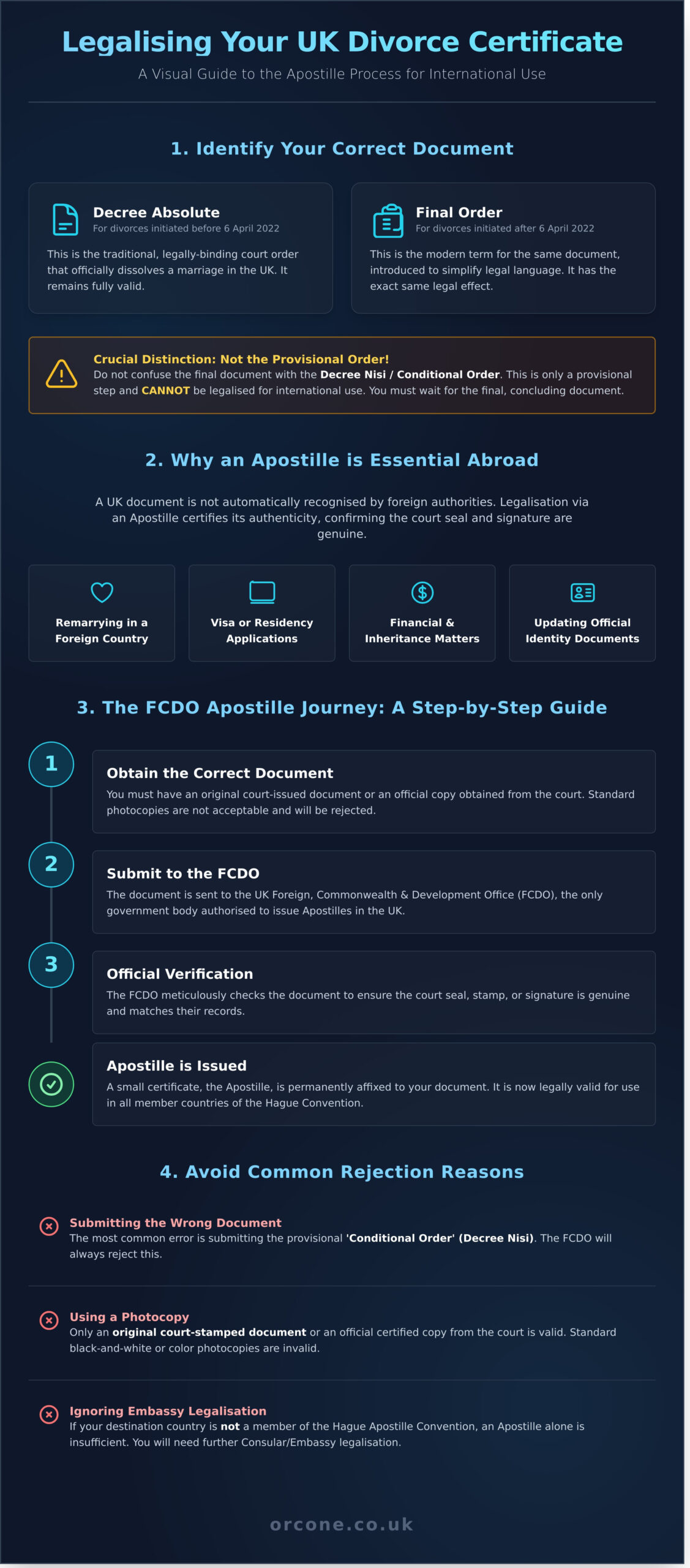
It is crucial to recognise that the official terminology has recently evolved. For any divorce proceedings initiated in England and Wales after 6 April 2022, the document that serves this function is now called a ‘Final Order’. While the name has changed, its legal effect and importance remain precisely the same as the traditional decree absolute.
Why the Name Changed from Decree Absolute to Final Order
The transition in terminology was introduced by the Divorce, Dissolution and Separation Act 2020. This landmark legislation was designed to modernise the divorce process, reduce unnecessary conflict, and simplify the language used. By replacing archaic terms with plain English, the legal system aims to be more accessible. If you hold an older document titled ‘Decree Absolute’, rest assured it remains fully valid and legally recognised. The two terms are often used interchangeably, but ‘Final Order’ is the correct contemporary term.
Decree Absolute vs. Decree Nisi (Conditional Order)
The UK divorce process operates in two distinct stages, and it is vital not to confuse the concluding document with its provisional predecessor. The first stage is the granting of a Decree Nisi (now known as a Conditional Order). This is a provisional decree confirming that the court sees no legal reason why the divorce cannot proceed. You can read more about the historical context and legal standing of a Decree Nisi to understand its role as an interim step.
Following the issuance of the Conditional Order, there is a mandatory waiting period of six weeks and one day. Only after this period has elapsed can an application be made for the Final Order. It is this final document-whether named a Decree Absolute or a Final Order-that legally terminates the marriage. Until it is granted, you are still legally married.
Why You Need to Legalise a Decree Absolute for International Use
While your Decree Absolute is the definitive legal document confirming the dissolution of a marriage in the UK, its authority does not automatically extend beyond national borders. Foreign governments and official bodies require a formal verification process, known as legalisation, to authenticate its origin and legitimacy. This process confirms that the signature, seal, or stamp on the document is genuine, making it valid for use abroad. As a key part of the UK’s legal records, a status detailed by sources like The National Archives, your decree absolute must undergo this critical step. For most countries, this authentication is achieved with an Apostille certificate.
Common Scenarios Requiring an Apostille
An apostilled document is essential in several high-stakes international situations where proof of your marital status is non-negotiable. Proactively legalising your document is a strategic step to prevent delays in critical life events, including:
- Remarrying in a foreign country: Most international marriage registrars require an apostilled Decree Absolute to prove you are legally free to marry.
- Applying for a visa or residency: When your eligibility is based on your new marital status or you need to update your records with immigration authorities.
- Settling financial matters: For inheritance claims, property disputes, or closing joint bank accounts overseas where proof of divorce is required.
- Updating official identity documents: To change your name or marital status on passports, ID cards, or other official records in another jurisdiction.
The Hague Apostille Convention Explained
The legalisation process is significantly streamlined by an international treaty: The Hague Apostille Convention of 1961. This agreement simplifies the authentication of public documents for use between member nations. If your destination country is a signatory, a UK-issued Apostille is all that is required for your document to be accepted. However, for non-member countries, a more complex, multi-stage process known as Consular or Embassy Legalisation is necessary. This typically involves verification by the UK Foreign, Commonwealth & Development Office (FCDO) followed by the destination country’s embassy in London. Unsure about your destination country? Check our legalisation guide.
Consequences of Not Legalising Your Document
Failing to legalise your document is not merely an administrative oversight; it can have significant and costly repercussions. Foreign authorities-including government agencies, courts, and financial institutions-will almost certainly reject an unverified document. This rejection can bring your plans to an abrupt halt, causing substantial delays in visa applications, marriage proceedings, or property transactions. The resulting complications often lead to financial losses, from non-refundable deposits to the cost of reapplying and express shipping documents. Investing in the correct legalisation process from the outset mitigates these risks and ensures your journey proceeds without interruption.
The Apostille Process for a Decree Absolute: A Step-by-Step Journey
Transforming a UK court document into a legally recognised instrument abroad is a journey with precise requirements. The apostille is the internationally accepted certificate that authenticates your decree absolute, but achieving this requires navigating a specific, non-negotiable process. Understanding the distinction between simply obtaining a copy and having it officially legalised is the first step towards a successful outcome.
Step 1: Securing an Official Court-Issued Document
The foundation of a successful legalisation is the document itself. The FCDO will only affix an apostille to an original court-issued document or an official certified copy. Standard photocopies are not permissible and will lead to immediate rejection, causing unnecessary delays and cost. If your original is lost, you must apply for a certified copy directly from the family court that handled your divorce proceedings. Attempting to use an unofficial copy is a critical misstep that will derail the entire process.
Step 2: Submission to the FCDO Legalisation Office
With the correct document secured, the next stage involves the UK’s sole issuing authority: the Foreign, Commonwealth & Development Office (FCDO). Its role is to verify the signature, seal, or stamp on the document, confirming its authenticity. The standard procedure involves submitting your document directly to the UK Government Legalisation Office, which then attaches the physical apostille certificate. While an e-Apostille service exists for some digital documents, a paper court order like a decree absolute typically requires this traditional paper-based process.
How a Specialist Service Optimises the Process
Navigating this bureaucratic journey independently can be fraught with potential delays. A specialist service transforms this complex requirement into a seamless, managed process. At Orcone, we manage the entire end-to-end legalisation, from document verification to final dispatch. Our expert checks ensure your paperwork is fully compliant before it reaches the FCDO, eliminating the risk of rejection. Through our established channels, we can often secure faster processing times, providing you with the peace of mind that comes from knowing your critical legalisation is handled with precision and efficiency. To learn how we can optimise this journey for you, visit orcone.co.uk.
Navigating Common Challenges and Ensuring Success
The legalisation journey for a decree absolute can present several friction points that, without foresight, may lead to costly delays. A successful outcome hinges on meticulous preparation and a clear understanding of the specific requirements set by both the UK Foreign, Commonwealth & Development Office (FCDO) and the destination country. By anticipating common pitfalls, you can transform a potentially complex process into a seamless one.
Verifying Your Document’s Authenticity
The most fundamental requirement is the validity of the document itself. The FCDO will only issue an apostille on a decree absolute that bears an original, wet-ink court stamp or an embossed seal from the issuing court. A simple photocopy or a document printed from an email will be rejected, as it lacks the official verification of the court. If your document is particularly old, faded, or damaged, it is prudent to obtain a fresh certified copy from the court that originally issued it to avoid rejection.
Managing Timelines and Urgent Requests
Effective planning is critical, particularly when facing deadlines such as an imminent wedding or residency application. Standard FCDO processing can take several working days, a timeframe that can extend during peak periods. This standard service is often insufficient for urgent needs. For those requiring a swifter resolution, specialist services are designed to significantly reduce this turnaround time, ensuring your documents are ready when you need them. Facing a tight deadline? Contact us for our express apostille service.
Requirements Beyond the Apostille: Embassy Attestation
It is a common misconception that an apostille is universally accepted. For countries that are not signatories to the Hague Convention, an additional layer of certification is required. This process, known as Consular Attestation or Embassy Legalisation, involves submitting your apostilled decree absolute to the London-based embassy of the destination country for their final stamp of approval. This adds complexity and time to the process, making expert guidance essential for navigating the bespoke requirements of each consulate.
Securing Your Future Abroad with a Legalised Decree Absolute
Navigating the legalisation of your decree absolute is a critical step in enabling your future plans, whether you intend to remarry, apply for a visa, or manage assets overseas. As we have explored, the Apostille process is the essential mechanism for ensuring your document is officially recognised, yet it demands meticulous attention to detail to avoid common pitfalls. The journey from a UK court document to a globally accepted certificate requires precision at every stage.
Rather than navigating this intricate landscape alone, partner with a specialist. Orcone ensures the seamless legalisation of your documents, offering a fast, secure service with expert handling of all FCDO and embassy procedures to prevent delays and rejections. As specialists in UK document legalisation for global use, we transform a complex requirement into a simple, successful outcome.
Streamline your document legalisation. Get a quote for our Apostille service today.
Let us manage the process, allowing you to move forward with absolute confidence.
Frequently Asked Questions
How long does it take to get a Decree Absolute apostilled in the UK?
The timeline for apostilling a document is contingent on the service selected. The standard FCDO (Foreign, Commonwealth & Development Office) postal service typically completes the process within 5 to 10 working days, excluding transit times. For more urgent requirements, premium same-day or next-day services are available through registered agents, offering a significantly accelerated turnaround. It is essential to factor in any preliminary solicitor certification time when planning your submission.
Can I get an electronic (e-Apostille) for my Decree Absolute?
While the UK FCDO does issue e-Apostilles, they are primarily for documents that are digitally issued and signed by a UK public official or notary. A traditional paper Decree Absolute must first be certified by a UK solicitor or notary public, who then applies for the e-Apostille on your behalf. Crucially, you must first confirm that the overseas authority you are presenting it to will accept an electronic version, as paper apostilles remain the standard in many jurisdictions.
What is the difference between notarisation and an apostille for a divorce certificate?
Notarisation and an apostille are two distinct stages of document legalisation. Notarisation is the process where a Notary Public verifies the authenticity of a document, signature, or a copy of an original. An apostille is a subsequent step, where a government body-the FCDO in the UK-authenticates the signature of the Notary Public or court official. An apostille gives the document official recognition in member countries of the Hague Apostille Convention.
My Decree Absolute was issued many years ago. Can it still be legalised?
Yes, the age of a decree absolute does not typically impede its legalisation, provided the document remains in good condition. The critical requirement is that the court seal and the signature of the issuing court official are clear and legible. The FCDO must be able to verify these features against their records to authenticate the document. If the original is damaged, you may need to obtain a certified copy from the court that originally issued it before proceeding.
What if my divorce was finalised outside of the UK? How do I get that document legalised?
The legalisation process must be completed in the country where the document was originally issued. A UK-issued divorce document is legalised by the UK FCDO, but a divorce certificate from another country must be apostilled or attested by the equivalent government authority in that specific nation. The UK FCDO does not have the jurisdiction to legalise foreign-issued documents. You will need to engage with the relevant ministry or an agent in the country of origin.
How much does it cost to get a Decree Absolute apostilled?
The cost structure for obtaining an apostille is multi-faceted. The FCDO itself charges a standard fee of £45 per document for its postal service. However, this does not include potential solicitor or notary fees for certification, which can be necessary. Using a specialist apostille service to manage the entire process can range from approximately £80 to £150 or more, depending on the urgency and complexity, but this fee typically includes all government charges.